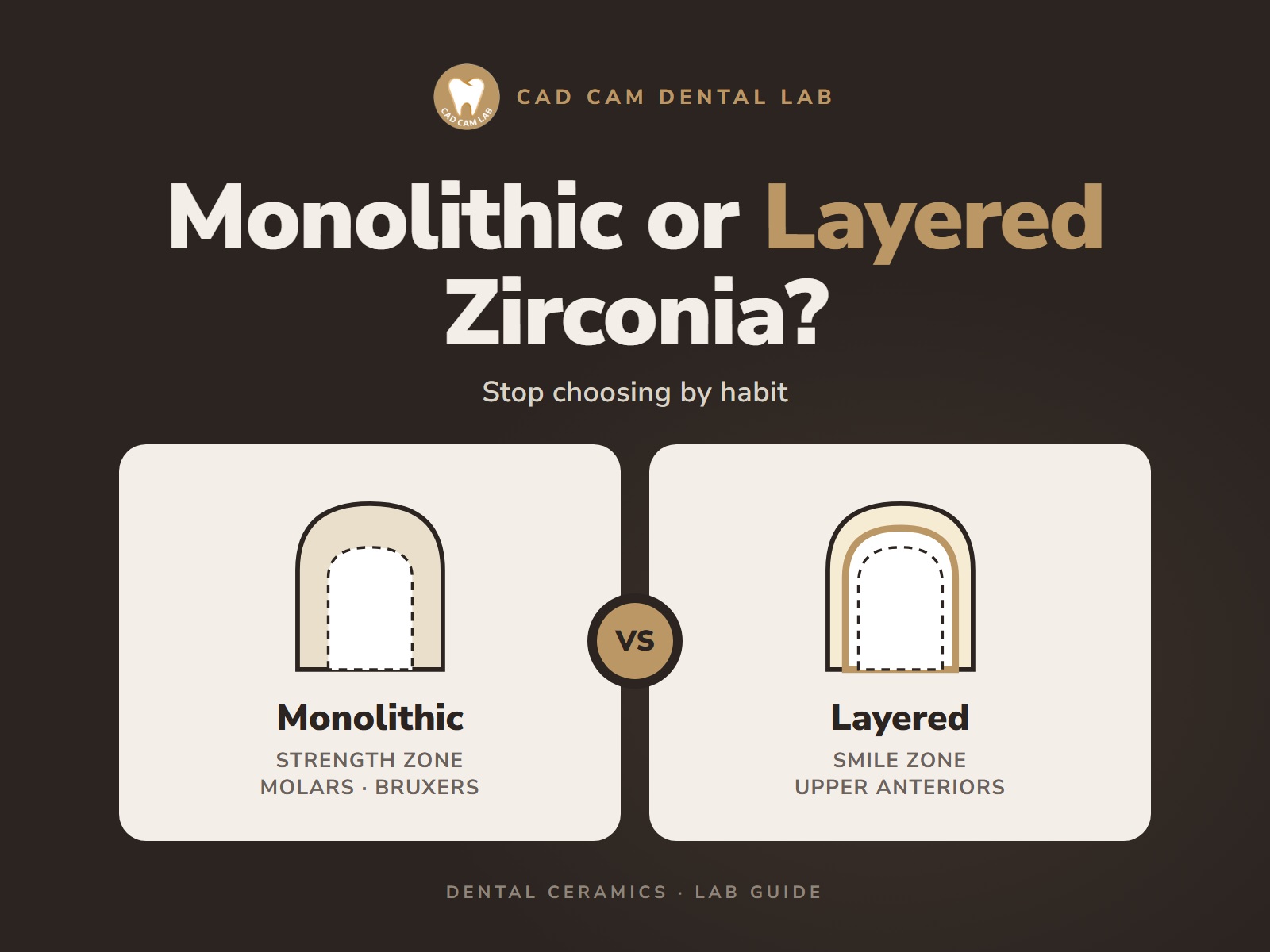
Monolithic or Layered Zirconia? Stop Choosing by Habit
Monolithic or Layered Zirconia? Stop Choosing by Habit
Every lab slip asks the same question: monolithic or layered? Too often the answer is whatever the clinic wrote last time. The better answer starts with the tooth: where it sits, how much load it carries, and how much of it the patient shows when they smile.
The short answer
Strength zone: Monolithic. Molars, bruxers, thin-space cases and full-arch cases.
Smile zone: Layered. Upper anterior teeth and hard shade matches.
In between: Cut-back technique. A monolithic crown with a buccal cut-back for visible but low-load teeth (premolar region) and full smile cases.
Long-span bridges: Hybrid technique.
What is the difference?
A monolithic zirconia restoration is milled from a single block of zirconia, then stained and glazed. There is no separate ceramic layer on top. A layered zirconia restoration has a zirconia core, with porcelain built up over it by hand to create depth, translucency and a custom incisal edge.
Strength zone: when to choose monolithic
Choose monolithic when the restoration has to work hard and the smile does not depend on it. It is the safer option for:
- Molars. They take the highest chewing forces, and strength matters more than a perfectly characterised surface.
- Bruxers. With heavy parafunction, the weakest part of a restoration is what fails first. A monolithic crown has no separate porcelain layer to chip.
- Thin-space cases. Without a porcelain layer, the restoration needs less room, which helps when the occlusal clearance is limited.
- Full-arch cases. Many units under load make a single, uniform material the more predictable choice.
Smile zone: when to choose layered
Choose layered when the tooth is on show and the result is judged by eye. Layering gives the technician control over translucency, depth and incisal character. It is the better option for:
- Upper anterior teeth. These are the most visible teeth in a smile and the most closely examined.
- Hard shade matches. When a single crown sits beside natural teeth, a layered build lets the technician reproduce the exact effect.
In between: the cut-back technique
Not every case sits clearly in one zone. For the teeth in between, we use the cut-back technique: a monolithic crown with a buccal cut-back, where only the visible buccal surface is layered with porcelain. It keeps the strength of the monolithic body and adds aesthetics where the patient sees it.
It is the right choice for:
- Visible but low-load teeth, typically the premolar region.
- Full smile cases, where the aesthetics must carry across several teeth.
Long-span bridges: use a hybrid technique
Note: for long-span bridges, it is better to use a hybrid technique.
Long-span bridges combine the demands of both zones: they carry a large load and still need to look natural. A hybrid technique lets the framework do the structural work, while aesthetics are added only where they are needed. Talk to our technicians about the design before the case goes to scan.
Tooth-by-tooth guide DOWANLOAD FREE TABLE
The guide attached shows how we select the material for each position, using FDI tooth numbering .
Monolitich vs Layered Zirconia . DOWANLOAD FREE TABLE
